
Water Rights, Settler Colonialism, and Environmental Justice
Water rights, settler colonialism, and environmental justice are intertwined. For Indigenous communities, water is not only a source of life but also a site of spiritual connection. However, water has historically been weaponized as a tool of control and dispossession, particularly within colonial and capitalist systems. Haiven 2013 engages with topics surrounding dams, discussing how these have historically transformed our environment and influenced our lives. He mentions projects such as mega-dams, which have culturally and physically represented exploitation, power, and control. Through exploitative and extractivist methods, settler colonialism has continually reconfigured watery spaces and waterways to serve economic and political agendas, often at the expense of the environment. Andersen 2004 examines the ecological history and ongoing initiatives to restore Long Island Sound, known for its waterways, as a functional estuary. He provides a thorough narrative beginning with the Sound’s geological origins and continuing to the contemporary issues it faced due to human activities. Voyles 2021 delves into the environmental history of Southern California’s Salton Sea, describing it as “an ecological conundrum and a study in paradoxes.” She traces the Salton Sea’s creation in 1905 when a canal failure caused the Colorado River to flood the Salton Sink, resulting in long-term ecological impacts.
The extractivist and exploitative practices rooted in settler colonialism not only damage the environment but also exacerbate harm toward Indigenous populations. Building on this theme, Claire and Surprise 2022 expose the environmental and social consequences of California’s water management policies, particularly those driven by the Central Valley Project (CVP), whose priority is to serve agricultural interests through water diversion. Dallman et al. 2013, critique the United States water policy for favoring urban and agricultural development at the expense of American Indian communities, particularly the Winnemem Wintu tribe in California. Water rights, therefore, are not merely technical or environmental issues, they are also political and cultural. Using the Standing Rock campaigns against the Dakota Access Pipelines project (#NoDAPL), Gilio-Whitaker 2019 explores a history of Native environmental justice, focusing on the struggle of Native American communities to protect their lands, cultures, and sovereignty against settler colonialism. Estes 2017 contributes a moving essay about the #NoDAPL movement as a continuation of the Oceti Sakowin’s historical resistance to colonial invasions. Todrys 2021 further explores this topic in her book that delves into the resistance to the Dakota Access Pipeline project (DAPL) at Standing Rock, where activists opposed the pipeline’s construction, which threatened their freshwater source. Meanwhile, Pauli 2020 addresses the Flint water crisis, focusing on how the cost-saving switch to the Flint River exposed residents to lead contamination and health risks. Demuth 2019 investigates the environmental history of the Bering Strait, exploring the relationships between humans, animals, and the ecosystem in the Arctic region over the course of two centuries.
Numerous scholars have contributed to the discourse on the intersection between struggles for water rights and environmental justice, all of which stem from settler colonialism. Taylor 2014 covers the concept of internal colonialism, which refers to the exploitation of Native American reservations and other marginalized areas within a nation. She draws attention to how harmful industries frequently operate in these areas, extracting resources and disposing of waste, endangering both the environment and the health of local population’s. Henry 2022 explores the intersections between environmental humanities and water justice, revealing how capitalism creates environmental risks and barriers in access to clean water for marginalized communities. Additionally, Hobart 2022 provides an interesting lens to view ice and cold, particularly as embodied in practices such as ice consumption. She positions ice as both a tool of dispossession and a site of decolonial resistance for the Kanaka Maoli.
Books

This work centres on the catastrophic ecological disaster that surfaced in the 1980s, when enormous marine life die-offs were caused by hypoxia, or oxygen depletion in the ocean, reaching critical levels causing Sound to plummet. Andersen further explains that the decline was a result of a gradual accumulation of pollution and neglect, which overwhelmed its innate capacity to manage nitrogen and led to a deadly ecological crisis.

Divided into five chapters, the book covers the commodification of natural resources like whales, walruses, and reindeer by humans, with a focus on how capitalist and socialist systems have impacted the region’s ecology and Indigenous communities. Demuth draws a comparison between the devastating impacts of modern industrialisation, fox hunting, and commercial whaling with the traditional Indigenous knowledge and practices that are more sustainable.

Drawing from the historical and contemporary experiences of Indigenous peoples, Gilio-Whitaker examines how environmental issues, such as resource extraction, and environmental racism, are connected to the legacy of colonialism. She demonstrates how practices like resource extraction can contaminate water, harming not only people but fish and plants that Indigenous communities depend on for sustenance and medicine. The book argues for a decolonised strategy that takes into account understanding and engaging with Indigenous approaches to environmental conservation and climate action.

In this piece, Haiven critiques how dams, despite their commercial and industrial uses, often displace communities, especially Indigenous ones, and cause environmental damage. Through literature, film, and cultural works, Haiven reflects on how dams represent humanity’s overconfidence in manipulating nature and the social and ecological repercussions of such manipulations.
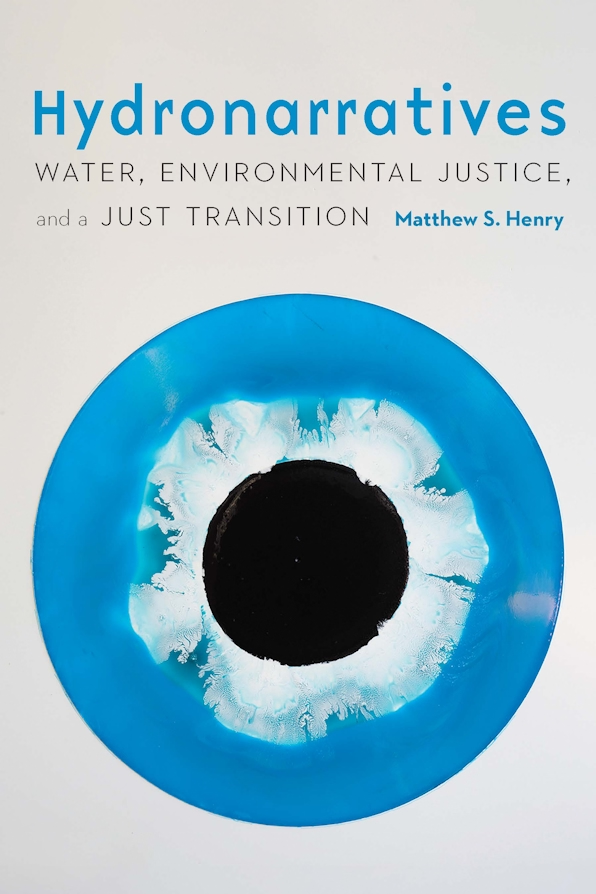
This is a critique of traditional energy humanities and its neglect of the broader impacts of water by using case studies that reveal the vulnerabilities of marginalized communities, especially Indigenous and racialized groups. The book contains four chapters on Indigenous hydronarratives, the Flint water crisis, the repercussions of extractive capitalism on rural Appalachians, and the impacts of sea level rise on marginalized communities and urban planning with racialized interests.

This work both critiques and contextualizes the larger discourse on colonial developments regarding Maunakea and the American ice trade by pointing out the racial and economic hierarchies within that history. The book argues that the thermal politics of cold are implicated in food systems, identity, and struggles for sovereignty and self-determination in Hawai’i.

This chapter examines how the reservation system contributes to the exploitation of Native lands and resources without the communities’ legitimate permission. It presents examples of how businesses like uranium mining, the disposal of toxic waste, and pollution from military installations have harmed the ecosystem and contaminated Native lands and water supplies like rivers and wells, impacting the health and way of life of Indigenous peoples.

The Standing Rock Sioux believed that the pipeline would destroy their sacred sites and endanger the Missouri River, a vital water supply for millions. Through the voices of Native activists such as LaDonna Allard, Jasilyn Charger, Lisa DeVille, and Kandi White, this book explores the core issues surrounding the pipeline, and the resistance against environmental injustices.
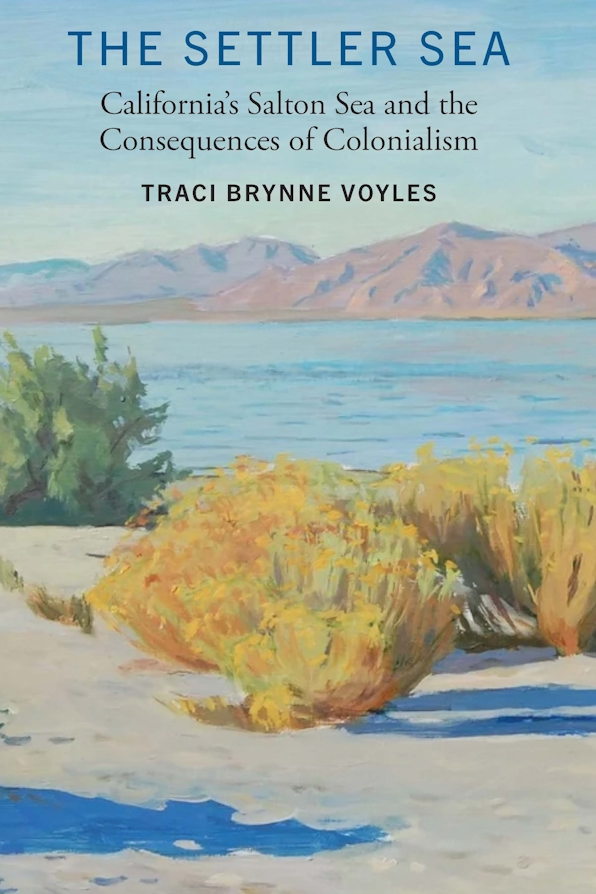
Voyles explains how colonization changed the area, from the forced displacement of Indigenous peoples like the Kumeyaay and Cahuilla to the environmental impacts of dams, agriculture, and industrial pollution. Her book, which is divided into eight chapters, delves into topics such as water manipulation, the appropriation of Native land and labor, and the long-term impacts of toxic dumping. Voyles combines historical data, oral histories, and archival records to trace the long-term damage inflicted both to the environment and Native communities by settler exploitation.
Articles

The authors argue that projects like water diversion have caused a “hydrologic rift,” that harms ecosystems and disproportionately affects Indigenous communities. They analyze how conceptions of water policy in California underpin both the capitalist and settler colonial systems, which in turns perpetuates Indigenous dispossession and ecological degradation. As an alternative, they advocate for “reciprocal restoration,” which includes actions like dam removal and floodplain reconnection to restore ecosystems and support Indigenous sovereignty.

Using interviews, Dallman et al. demonstrate how environmental policies benefited the economy, disregarded the cultural and spiritual ties that Indigenous people have to their sacred landscapes, and restricted their access to the ancestral lands.

This essay depicts the solidarity that stretched over more than three hundred Native nations and the environmental perils caused by the Dakota Access Pipeline. It contextualizes these contemporary struggles within a long history of injustices, such as violent suppressions like the Wounded Knee Massacre and policies designed to divide Indigenous communities. The narrative promotes urgency in seeking unity among Native and non-Native allies in resisting state repression and defending their treaty rights and sovereignty.

This insightful article examines the technical failures, such as inadequate water treatment and the impact of corrosive water impact, on aging infrastructure. The article gives attention to the political decisions that prioritized financial considerations over public health. It also explores the socioeconomic and racial sides of the crisis, showing the environmental injustice and systemic neglect that are faced by the communities in Flint.